




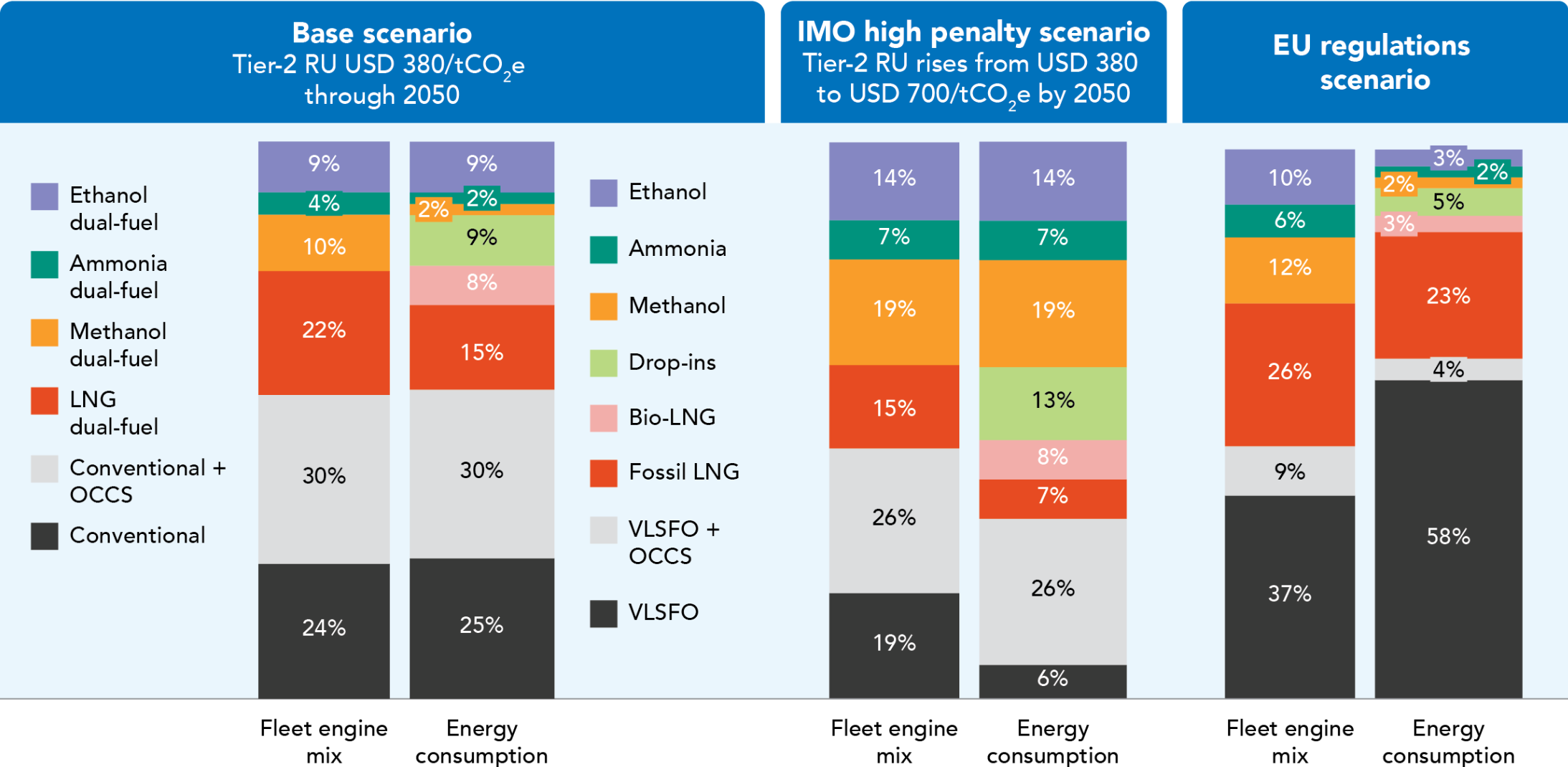
 A carbon penalty of $380 per tonne of CO2e would leave conventional marine fuels more economical through 2050, while a charge rising to $700 could shift about 61% of global fleet energy consumption to new fuels, according to the Global Centre for Maritime Decarbonisation.
The study, produced with Boston Consulting Group, examines how fuel costs and regulation could shape newbuilding engine choices, fleet development and bunker demand through 2050. Its base case assumes the International Maritime Organization’s proposed Net-Zero Framework is adopted and that its Tier-2 remedial unit penalty remains at $380 per tonne of CO2e through 2050.
The draft framework itself sets the initial Tier-2 price at $380 for the 2028-2030 reporting periods, with prices from 2031 yet to be determined.
Under the base case, about 10% of fleet engine capacity in 2050 would be capable of burning methanol, but methanol would supply only 2% of fleet energy consumption, as conventional fuels remain cheaper.
In the high-penalty scenario, the Tier-2 charge stays at $380 between 2028 and 2030 before rising linearly to $700 per tonne of CO2e by 2050. New fuels, including drop-in alternatives, then account for about 61% of fleet energy consumption. VLSFO with onboard carbon capture and storage contributes another 26%, while conventional VLSFO and fossil LNG together fall to about 13%.
The study found little overall cost difference between e-methanol and e-ammonia by 2050. E-ammonia has a production-cost advantage, but this is offset by higher downstream costs linked to storage, engine investment, crew training, exclusion zones and more complex bunkering.
Hydrogen costs account for about 54% to 60% of the total levelised cost of both fuels. If hydrogen falls to about $2 per kg by 2050 from the roughly $3 per kg assumed in the base case, methanol and ammonia together could provide 36% of fleet energy demand.
The study covers 12 fuel pathways and six engine configurations. With ships typically operating for 25 to 30 years and only around 4% of the fleet renewed annually, more than half of vessels operating in 2050 are expected to originate from orders placed before 2035.
“The carbon price required to close this gap is substantial,” GCMD chief executive Lynn Loo said.
GCMD was established in Singapore on 1 August 2021 as an independent maritime decarbonisation organisation and has more than 130 centre- and project-level partners.
Boston Consulting Group, founded in 1963, is a global management consulting firm. It had about 33,500 employees in 2026 and generated $14.4bn of revenue in 2025.