




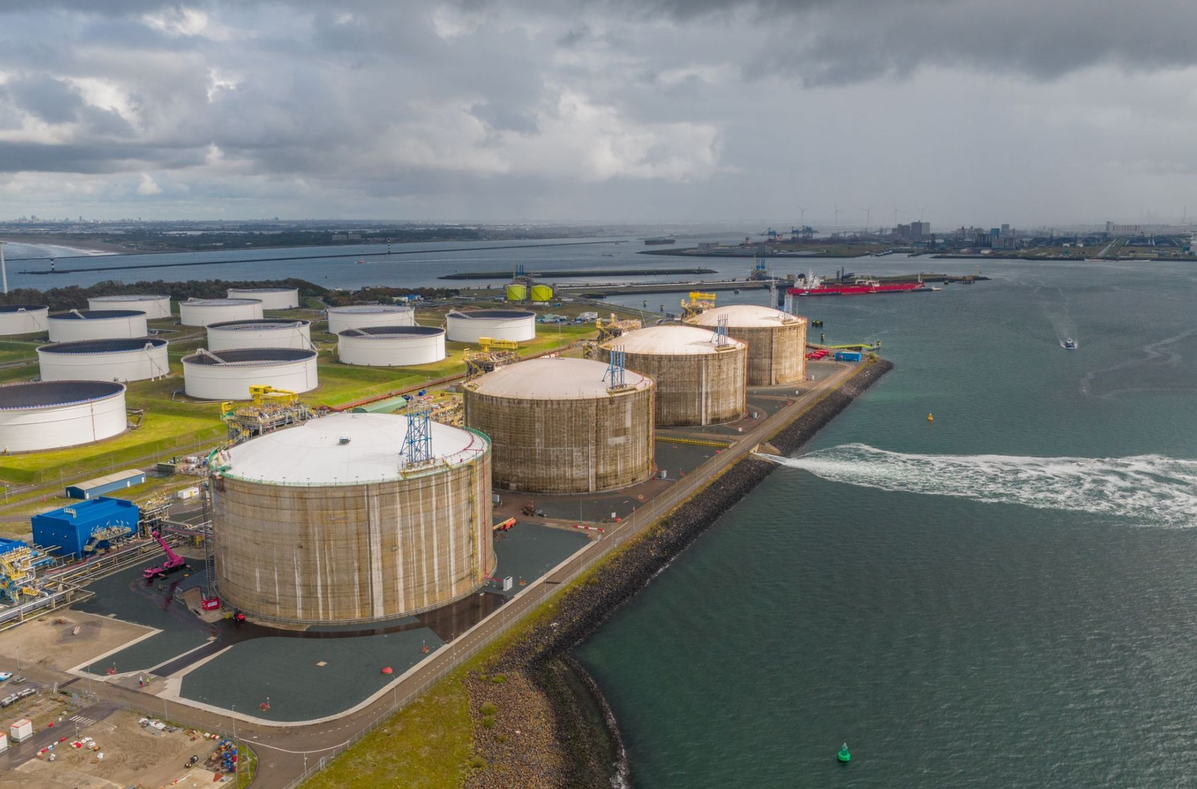
 Dutch LNG import terminal Gate has commissioned a fourth storage tank in Rotterdam, raising annual regasification capacity by 4 billion cubic metres to 20 billion cubic metres, according to a Gasunie statement.
The 180,000-cubic-metre LNG tank entered service on 1 October after a three-year construction period. The project was approved partly in response to the 2022 energy crisis. The Dutch gas market is about 30 billion cubic metres per year.
“With the commissioning of this fourth tank, we achieve an important milestone. Gate is expanding its capacity and strengthening its role as a strategic gateway for the energy supply of the Netherlands and Northwest Europe. The ability to supply LNG from various parts of the world helps Europe further diversify its energy supply and enhances security of supply,” Gate managing director Jarmo Stoopman said.
The Port of Rotterdam Authority is building Jetty 4 after a final investment decision in January 2026. Small-scale ship loading and bunkering are expected to start by the end of 2028.
Gate also launched a non-binding expression of interest on 31 August 2026 for future loading capacity at planned Jetty 5 as it considers further expansion to meet demand for cleaner marine fuels.
Gate Terminal B.V. operates the LNG import and regasification terminal and is a joint venture between N.V. Nederlandse Gasunie and Koninklijke Vopak N.V.
The terminal receives LNG by ship, stores it in liquid form and regasifies it for delivery through the gas transmission network to the Netherlands and neighbouring countries.
N.V. Nederlandse Gasunie is a Dutch energy infrastructure company wholly owned by the Dutch state. Its activities include large-scale energy transport, storage and conversion infrastructure.
Koninklijke Vopak N.V., or Royal Vopak, is a Dutch public limited liability company providing storage and infrastructure services for liquid and gaseous products at ports worldwide.
Havenbedrijf Rotterdam N.V., the Port of Rotterdam Authority, is a Dutch public limited liability company that develops, manages and operates Rotterdam’s port and industrial area. Its shareholders are the Municipality of Rotterdam with 70.83% and the Dutch state with 29.17%.